Search This Blog

Monday, 11 October 2010

BT takes IDNet down

Read more! No-one else seems to have reported it, so I will. Last night, just before 8pm, IDnet, which serves a considerable number of homes and businesses around the country, went kerflump.

This blog post can be read at 5tth.blogspot.com


Last night, after trying several different routers, I for one was damned glad to have an ISP who answer their phone at 10pm on a Sunday eve. "Yep, we're all down. It's something to do with BT Central, and no time is yet being given for restoration of services." So, early night then as unable to work. (Oh yes, that'll be because the mobile coverage in this rural area isn't sufficient to make mobile broadband an option, and there is no 3G here, whatever the coverage maps say, nor is it possible to have a second broadband line to the office as...yep, you've guessed it, no spare lines in the village!).

This morning, the system is back up and working and the idnet network status messages read as follows:

"2010-10-10 20:21: Both our Primary and Backup Broadband links into BT are currently down. BT are aware of the failure and are investigating. We do not as yet have a time estimate from them for a fix. We will provide an update as soon as we get one."

"2010-10-11 01:46: Service has now been restored. We are demanding a full explanation from BT.
2010-10-10 23:59: BT confirm both circuits tested OK. They are now diagnosing their internal network routing.
2010-10-10 22:18: BT now have engineers onsite in the Exchange diagnosing the problem."


But better is yet to come.

"2010-10-11 08:10: BT have admitted that someone removed the configuration for our circuits yesterday. We and (sic) demanded that they investigate why this happened, what safeguards will now be put in place to ensure that it can't happen again and why it took them so long to resolve the issue."


idnet downtime, BT fail

I don't know exactly how many customers idnet serve, but if it hadn't been a Sunday night, no doubt there would be others reporting the outage, including Govt agencies looking at that link above.

I look forward to the explanation from BT. And it clearly highlights how no country should rely on a private company that could prove to be the single point of failure.
Read more!

An every day tale of farming folk.

Read more! An important video
This blog post can be read at 5tth.blogspot.com

Why digital technology is important to me. And my family. And my farm.

This video has been made for Sheffield Docfest Digital Revolutions to highlight how technology has changed a farmer's wife's life. Watch, enjoy, comment, tweet, and share!!


Read more!

Saturday, 9 October 2010

East Coast Wi-fi Fail

Read more! Oh dear, as I feared... The improved service isn't improved very much, and now we have to pay for it.
This blog post can be read at 5tth.blogspot.com

As I mentioned on an earlier blog posting East Coast Trains are about to introduce, and indeed have introduced charging for their on-board wi-fi.

I'm sitting on board one of their stationary trains and I've just had a go with their new 3G/HSPA chargeable wi-fi and it's not very good. It's marginally quicker than what went before, but there aren't many people on board, so pretty low contention ratio.

I'm now using my 3G dongle which is much better. Would I pay £4.95 for an hour's use? Er, no when I can get something much better for £5 a month.

I suppose the bottom line is `How many people will pay?' given that many nowadays have 3G dongles and a lot can be done with a Blackberry or i-Phone.

It'll be interesting to see how long before it's switched off.
Read more!

Thursday, 7 October 2010

Into Africa

Read more! This will be an interesting one to watch
This blog post can be read at 5tth.blogspot.com

This could provide evidence of the economic benefits of a good fbre connection
Read more!

1 week reminder for call to papers for FTTH Council

Read more! If you haven't been already to a FTTH Council conference, make 2011 the year that you do. And if you haven't submitted a paper yet, remind yourself you have just one week-ish until 15th.

This blog post can be read at 5tth.blogspot.com


This will be my 4th FTTH Council conference (first was Amsterdam and I still have my torch!), and I know that it is now beginning to get very embarrassing about the lack of delegates, let alone speakers, from the UK. Many others will support me in saying that it is time we Brits got ourselves to this conference to learn from the very valuable information that is propagated at this event. Not just from the stage, but the networking is also truly astounding.

I might submit a paper "Why the UK is sooooooooo far behind all of you in Europe and ROW"....wotcha think?!

Read more!

Wednesday, 6 October 2010

Satellite broadband in the final third

Read more! Ended up "helping out" (also known as passing on a message!) a far flung neighbour who has a satellite connection from BeyonDSL today. We have some pretty inclement weather up here in Cumbria, and recently we have had some seriously heavy rainfall and winds....

This blog post can be read at 5tth.blogspot.com


The satellite connection stopped working yesterday, which is rare, even with our weather. I'm not a satellite tech support service and would never claim to be so, and sent a text message to Mike Locke, the MD of BeyonDSL to report the problem on their behalf. The BeyonDSL service was used to supply backhaul to Rheged for Rory's Broadband Conference so I finally met Mike there at the colloquium. (Aside: how come one of Cumbria's major conference centres and visitor attractions, within spitting distance of the fibre up the M6, didn't have a decent connection until BeyonDSL stepped in?)

Anyway, the MD rang the farmer, who belayed the mesage to his own techie, Terry, up the road (who shares the connection through a wireless link which had to be set up to go under the Settle-Carlisle railway bridge between them!), and using the diagnostics tools, they found a break in the cable where it comes out of the farmhouse. I hesitate to add that I know this satellite cable runs into a high turret on this 15th century farmhouse, so I dread to think where Terry was, but you can imagine the cable has taken some gyp high up on that exposed wall.

Before the break showing a really marginal signal of 8.5dB


satellite connection before repair


satellite connectivity after repair

and then Terry fixed the cable and the second photo shows after the break - an excellent signal of between 11 and 12dB

The points being that:

1) This hamlet doesn't have sufficient phone lines into it for the number of houses and BT seem reluctant to provide more without someone parting with the odd arm and leg and three, and no mobile coverage to speak of for most networks. So, satellite is a TODAY solution, wherever you are.

Yes, there may be some issues like latency, caused by the fact that the satellite is roaming around the earth at a height of about 20,000km, but for many users a satellite connection means you can do the internet basics such as email, watch iplayer, surf, make a VoIP call etc. You can't game if it's about split second timing, but some of us would lose the battle whatever connection we were on!

2) You can't beat a problem being sorted out this quickly and at no cost, apart from a phone call and the Big Society approach to getting, and keeping, everyone connected.

If you haven't considered satellite, then take a look at the packages for BeyonDsl - they do work out at the same as a mid-range ADSL connection (cheaper than mine but I wouldn't swap my provider for the world - SWBB - especially not for some dreadful customer service which many other ISP users report, regularly). And for all those organising conferences espousing satellite as part of the solution for the USC, don't forget that BeyonDSL provide conference backhaul at very short notice as well as being good speakers!


Read more!

The energy and thinking behind the paradigm shift

Read more! Graham Small of AFL Fujikura has contributed after he 'let slip' that AFL Fujikura were involved in the Chattanooga smart grid.

This blog post can be read at 5tth.blogspot.com


Unless you have been off-planet, you will know by now that Chattanooga in Tennessee launched a 1Gbps network on 13th Sept to residents and businesses. It has been a collaboration between the electricity company, the community and a global fibre company. It shines the light for every other country, region and community to follow.

Graham writes:

When the utility companies get together with high tech fibre companies then real paradigm shifts can occur….

We have a huge communications and utilities infrastructure in the UK that reaches just about everyone in our nation. Every utility we have provides some means of delivering an optical fibre into someone’s home. Some are tried and tested – a physical drop into a customers premises via duct or aerial means, via the water system (mains or waste) or via the mains gas (optical fibres are inert, non-radiating or likely to produce sparks). The associated trunk infrastructure provides the ideal highway for core and backhaul if we have the wit but to utilize it. BT isn’t the network – there are alternatives!

Once every home has an optical fibre then the possibilities are endless. From the utilities perspective this is an ideal medium for “smart metering” and a huge cost saving in sending a ‘man in a van’ to every household to check the gas, electricity or water meter. We already have bundling of gas, electricity and telephony through utility providers so why not the fourth utility? Indeed, do we even need computers to enable the internet? Cloud computing suggests that we don’t necessarily need our clunky old PC to do everything we want to do “on line”; how about “Smart TV” that provides a fully integrated communications platform offering Telepresence and truly Unified Communications?

This is the dawn of the age of the Stupid Network. Fibre is the conduit that can provide the catalyst for a new age. Think Caxton’s printing press through to the age of manned space flight. We are at the start of another exponential growth spurt breaking down barriers between people, communities and countries; between the voters and their Governments; between health professionals and their patients; between entertainers and the entertained.

OK people, let’s get smart - the view that connecting people to the internet is all about Facebook and Foxy Bingo is dead wrong. It is the catalyst for social evolution and a template for building an Arthur C Clarkian utopia. The industrial revolution was a catalyst for major social change, fuelling the brawn drain from rural communities to the “dark satanic mills”. The communications revolution will fuel a mass migration back, mitigating the need for mass conurbations and providing opportunity for our talented youth to develop 21st century businesses based on 21st century technology.

It takes a BIG Government to enable a truly BIG Society if it can appreciate the BIG picture!


Read more!

Radio Lentil - Lloyd Felton

Read more!
The Rural Broadband Partnership does what its name says on the tin!
This blog post can be read at 5tth.blogspot.com


RBP was founded by Lloyd Felton, who is Director of County Broadband and is now supported by the Federation of Small Businesses (FSB), Country Land and Business Assocation and many other regional organisations.

The website offers all communities and parishes who are planning a community broadband network, or who already have one in place, the chance to join with others. The map clearly shows how many communities are getting on with providing high speed broadband, and not all are rural. There are quite a few missing though so if you know of a project, add their details or encourage them to add themselves to the community broadband map.

RBP has presented parishes and communities with the ideal resource for accelerating deployment of next generation access, both to rural and urban areas. As it moves into its next stage of development, with growing support from a wide range of organisations, RBP will be bringing together the information required for any Parish to self-organise to bring NGA to its community. The Final Third First campaign highlights what an enormous issue the potential market failure could prove for this country - both economically and socially.

Listen!


Read more!

Radio Lentil - Miles Mandelson

Read more!
Great Asby Broadband, a small village broadband network in Eden, Cumbria, is a prime example of community JFDI. Miles Mandelson is the Chairman.

This blog post can be read at 5tth.blogspot.com


Miles is responsible for producing the Parish Guide to NGA which is essential reading for any Parish Council.

Great Asby has received RDPE funding to both extend its network and increase the backhaul capacity, so exciting times lie ahead! Mark Holdstock interviewed Miles for Radio Lentil-Miles Mandelson Part 1

Listen!

Miles Mandelson - Part 2

Listen!

Read more!

`Big Society' hits stormy waters?

Read more! Could The Big Society face problems over its credibility, in the same way that the famous Labour idea of The Big Conversation did?.
This blog post can be read at 5tth.blogspot.com

There are a lot of hopes pinned on The Big Society being at the heart of the provision of fibre to Notspots, by the people in those Notspots, but this article in the Guardian sounds a warning note about the concept. One of the biggest challenges facing politicians is tapping into The Zeitgeist, tuning yourself into the way that the majority of people are feeling.

As the article above shows, there are signs that The Big Society could be seen by some as another part of the cuts armoury. The Zeitgeist could turn against it.

Whilst those involved in the Fibrevolution know it is something very different, a means for achieving the aims of dragging the country, and the countryside's internet provision into the 21st Century, we must be alert to the fact that if it becomes politically inconvenient to the government, or used as a symbol of the unpopularity of the cuts, it could be dropped quite rapidly.

I suppose that what I'm saying is that there should be a Plan B, just in case. Perhaps focussing on the removal of obstacles to communities putting in their own fibre networks, something which can be de-coupled from the Big Society if necessary, but still achieve some very useful things . The removal of obstacles is far less politically vulnerable, as it isn't directly associated with the cuts

Lots of shouting at one public meeting may not spell the end for the concept, but it could cause problems further down the line, especially if it is widely picked up by opponents of the spending cuts, and at the moment feelings are very fragile amongst many people who may have voted for the government. Watch the Zeitgeist very carefully.
Read more!

Tuesday, 5 October 2010

Infinity and Beyond

Read more!
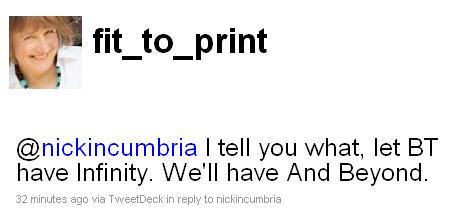
For those of you who don't use Twitter....big up to Ali @fit_to_print for this tweet!!

This blog post can be read at 5tth.blogspot.com


Care to respond, BT?!

Read more!

Race to Infinity?

Read more! Don't make me bloody laugh. An infinitely long wait for anything approaching what other countries have is what the latest BT marketing campaign will achieve for most.

This blog post can be read at 5tth.blogspot.com


Seen all this before. Look what the trigger levels did for huge swathes of the country? Kept us tied into a private company's infinitely slow roll-out of 'true broadband'. In fact, we still aren't there yet as few have a symmetrical connection, which is what is required to use the Net, services and applications.

I refuse point blank to link to the website promoting this farce. Anyone who registers on it instead of investigating the options for DIY FTTH is permitting a private company to lead this country into yet more years of broadband darkness. This type of data harvesting in private will lead many investors to hesitate to put money into a badly needed utility instead of JFDI.

Personally, I think that what is required is a concerted campaign to either
a) pull this website immediately OR take it from BT's greedy little paws and put it in the hands of an independent group who have the well-being of the nation not shareholders at heart

or b) insist that all data is made open access for all (exactly as any FTTH network should be) immediately the competition ends. After all, if these people want better broadband, they won't mind being contacted by EVERY COMPANY willing to get on and do it in their area, will they? It's called CHOICE. It's called a COMPETITIVE MARKET. And it's what every consumer in this country should have a right to.

In addition, what should be put on that site are links to every bit of news and information about FTTH that BT can lay its hands on to ensure that any website visitor is given full and unbiased knowledge about just what is feasible in this day and age without BT needing subsidies from the public purse. BT are gathering data from every single exchange in order to justify doing 5, which won't even be in the Final Third, which would have made the most sense to show the level of demand in rural areas and the true commercial viability of such exchanges.

AND there ought to a clearly laid out promise that BT will do ubiquitous FTTH, and not FTTC or BET, to any exchange area that it decides is viable from a 75% trigger.

Watch 2012 be the year that BT makes approaches to every regional source of funding declaring certain exchanges are not viable....


Read more!

Monday, 4 October 2010

Interesting articles in the papers

Read more! The troops are being lined up against LTE, and BT strives to show how much it really cares. I love the smell of fear in the morning.
This blog post can be read at 5tth.blogspot.com

There's an interesting couple of little snippets in the papers this morning firstly in the Independent, there's the dire warning that `New generation mobile phones will ruin cable TV signals' and then on the BBC website that `BT competition seeks out UK's next fibre hotspots'

What is interesting about these two stories is that they give a strong sense of the dinosaurs shaking their fists (or whatever these early reptiles shook) at the asteroids hurtling towards the earth, which would eventually wipe them out.

The cable companies have a lot to lose from LTE, because it could deliver exactly the same sort of content, but at the same time be portable. The scenario is that with one account, and one piece of kit you could get all the internet you need, and when you go on a camping holiday holiday you just take your phone, and the associated wireless router with you, and it's laptop heaven for the kids who can surf their evil social networking sites till the cows come home, or perhaps trample the tent.

The other story is interesting because it gives an insight into the mind of BT. There will be some people in the organisation who will see some of the broadband/Fttc/Ftth projects which have been set up by local community interest companies, which in effect largely exclude BT. Newton Upon Rawcliffe is a prime example, where people have in effect by-passed BT to get a reasonable speed of Broadband.

When you get up to 5/10Mbps you don't actually need a phone, Skype and similar packages become just as convenient. The fear in BT is that if they don't act soon some reasonably sized communities could simply by-pass them, and be lost for good.

LTE may not be the ideal solution where Ftth is the Holy Grail, but it might bring some comfort to rural areas when it becomes available. It could offer possibilities if it is rolled out alongside the main motorway and rail networks.

The closest comparisons to the chill that the conventional providers may be feeling is telephones in hotels. Remember when making a phone call from your hotel room cost upwards of a pound a minute, well does anybody actually use hotel telephones now, since the arrival of mobile phones?

The warning is stark to the established industry, provide or die.

There are parallels with mobile phone coverage. When I first moved to Teesdale sixteen years ago the only network with any kind of coverage was Orange. I changed to Orange, and most of the people around me signed up too. Now Orange is the dominant network, because even though others have improved their coverage Orange got there first and like banks, most people are reluctant to change.....

There is a lesson here for the established internet telecommunications industry.

Read more!

Saturday, 2 October 2010

Comments on Cornwall

Read more!

It seems that the latest (supposedly) super-fast broadband tender has caused a huge furore. If you want to comment (named or anonymously) come and have your say, and join the throng. Are you a resident of Cornwall? How do you feel about the process and result? Are you a supplier in the South West? Are you a business in the Digital Peninsula? Were you involved in the tender process? Come and have your say on 5tth....

This blog post can be read at 5tth.blogspot.com


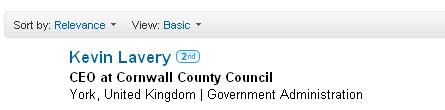
Oh, next week should be fun! I am trying to get hold of Kevin Lavery (ex-BT and now CEO of Cornwall Council - interestingly, or oddly, based in York according to LinkedIn).

If you have a question you would like to put to him, please add to the comments - you can post anonymously. This is not going to go away so....as I said previously....other areas, beware.
Read more!

New Media (isn't) in Eden, Cumbria

Read more! "Mum, can you post me a copy of the Herald?" (our local paper) "I can't find out what is going on at home at all".

This blog post can be read at 5tth.blogspot.com


So I did. And then I googled our area, as did John Popham after his recent Big Society visit to Eden.

Sproglet is right. There's little to tell her online about what is going on up here, and the local newspaper site is pretty awful. Worse, the lesser-known Eden Messenger still doesn't know there has been a broadband conference here that everyone is talking about! (Until they catch up, I refuse to link to them).

So, hell, let's have our say:

Dear Sir/Madam and everyone involved in the Herald

Once again, we have just witnessed an exodus of our youngsters to colleges, universities and new jobs outside of Cumbria. The debates about why this is necessary could continue long into the winter months and beyond.

What is telling is that they want to keep in touch with 'home'. The cwherald website fails utterly to allow them to do that. How many times do I need to send a copy of the Herald (by post) to Wales and West Yorkshire to my offsprung, whilst other counties manage to update their websites, run Facebook pages, set up Twitter accounts for breaking news etc? I don't want to use up scarce environmental resources just to send a paper version of the local news. It seems wrong.

Many of us understand the economics of new media and we struggle to understand the Heralds' failure to keep up with the requirements of today's audience. Three stories from each edition on the website plus a couple of letters is never going to encourage anyone to purchase the paper edition. All you are doing is forcing potential purchasers away from your paper to online, live, dynamically generated news publications, such as those produced automatically through paper.li.

I hope those in charge of the Herald will accept that the next generation of readers are out there, using the next generation of applications and services to stay in touch with home. iPhone apps, Twitter, and Facebook pages are how these youngsters (and oldies) want to access our local news. Please, catch up, or your sales will only drop, and others will step into the breach by providing up to date, online, Cumbrian news.

Regards

I'm not holding my breath. I suspect the Herald is run by a bunch of people who, like many others in the 'industry', believe we are all going to tire of our new-fangled phones and computers, and go back to buying recycled paper......
Read more!

Friday, 1 October 2010

Off the dial, in the Notspots, the only source of culture could be the fridge

Read more! For the tech savvy the new cultural revolution is here, but if you've got a crap connection you'll be left behind.

This blog post can be read at 5tth.blogspot.com


I sit here on a Friday night listening to an album which is rather delightfully entitled `Swallow This Turd'. It is a sampler album of American `Popular Beat Combos' signed to the Tic Tac Totally label, which has been heavily featured by the excellent Tom Ravenscroft (the son of the late John Peel) on his BBC 6 Music show.

This is where I am so thankful not to be in a Notspot. Being an anorak I consume my media in a very different way to how the broadcasters, and indeed the music industry intended. For instance the original radio programme which featured the album was recorded onto my computer from the BBC i-Player, strictly speaking a bit naughty, but essentially it's no different from taping it. Infact I used to have a DAB radio (since deceased) which would record DAB direct onto an SD card as MP2 files and those could be converted to MP3 in i-tunes and put on my i-pod, which is then plugged into the USB socket on my car stereo.

In essence I can record programmes, some very good programmes which are broadcast late at night, and then listen to them at a time of my choosing. Radio 3's outstanding Late junction programme has on occasions been my breakfast time listening.

To be able to do this, from the i-player I need to have at least 2mbps, otherwise it buffers, and pauses every couple of minutes. To get at this free download, which is actually rather good, I had to download a 135Mb zip file... On my connection it took about 20 Mins, which is quite bearable. My laptop is female and it can multi-task, although waking up in the morning is more of challenge.

I can also download podcasts, videos, and other AV stuff where I access more of my culture these days than TV.

The simple message is that the delivery of culture is becoming more and more dependent on digital connections. Without a good connection people are missing out, and potentially the arts are suffering.

In part the BBC has to be aware of the fact that there are a lot of people who can't `listen again' or use the i-player, and pressure has to be put on the corporation to, in turn to put pressure on the DCMS to ensure that everybody who pays the licence fee has the ability to access the content, and at the same time on-line campaigners should take the opportunity to get the arts onside. Many bands make it via Myspace and other on-line music sites. And a lot of music is also sold on-line

I'm only listening to this lively little sampler LP because I can get 2Mbps, in the past it wouldn't have stood a chance.

If the title `Swallow This Turd' provokes your curiosity it's here type in a valid e-mail address and it will send you a link to the download.
Read more!

Thursday, 30 September 2010

Radio Lentil - Aidan Paul

Read more!


Aidan Paul the Chief executive of Vtesse Networks talks to Mark Holdstock.
This blog post can be read at 5tth.blogspot.com


Aidan Paul Part 1

Listen!

Aidan Paul Part 2
Read more!

FTTH Council Call for Papers

Read more! The FTTH Council Conference in Milan in 2011 will be a must attend event, as always, and the call for papers has been extended to Oct 15th.

This blog post can be read at 5tth.blogspot.com


There are many who read this blog who have fascinating insights into FTTH, particularly in countries where there has been little movement so far on deploying FTTH! Get your papers in and be a speaker at the EU FTTH Conference.
Read more!

Digital Peninsula gets um NGA?

Read more! Quelle surprise (not) - BT win the Cornwall bid
This blog post can be read at 5tth.blogspot.com


OK, how are we going to define NGA if the BBC and the incumbent continue to define TODAY'S connectivity as 'next generation'? Up to 40Mbps and up to 100Mbps are NOT and never can be next generation. After all, there are far too many who have far more than this in 2010 - Chattanooga, Hong Kong, Korea - the list is endless.

The statement that this will give Cornwall a head start is IMHO misleading to EVERYONE. Head start on who exactly? Certainly not those already in the FTTH Council EU league table - Denmark, Latvia, Estonia, Lithuania, Czech Republic etc. Even the Shetland Islands are putting in fibre.

How long are we going to permit a continuance of this hype and what are tantamount to outright lies? The UK is light years behind (literally, when it comes to fibre to the home) and the sooner we accept that and up our gameplan, the better. Up to 40Mbps in 2014 is simply not going to solve the problem. We are back to the sweating the copper asset game again with this latest tender announcement.

And let's consider again the BBC report:

The aim is to give between 80% and 90% of businesses and homes access to fibre broadband by 2014, the project's partners say.


Followed two paragraphs later by:

The project, which includes the Isles of Scilly, would see direct fibre optic connections to half of the county's businesses and homes, allowing download speeds of up to 100Mbps (megabytes per second)(sic), managers said.


So, (breathe in) 80-90% (breathe out) 50%. Who is going to pay to upgrade the half who are not getting FTTH? Is BT going to sub-loop unbundle in all the cabinets and let the community dig their own fibre? How far are some of the street cabs from rural properties? Can we see some facts and figures about the likely connectivity the most rural and remote are likely to get? And when might that upgrade from copper to fibre be likely to occur? Because if I was sitting in Cornwall today in one of the likely 'uneconomically viable according to BT' locations, I think I'd start looking for a property in Latvia.

And don't get me started on why there is, as ever, no mention of that all important factor for true next gen - SYMMETRY.

Fibre broadband means that you have fibre to the consumer, not to some part of your network, be that a cabinet, exchange or anything else. Just because Virgin Media got past the ASA with this manipulation/mangling of the English language, doesn't mean it should be permitted to continue.

Yes, there is still a 10Mbps internet, but moves are afoot which will see an upgrade in that, (IPv6 etc) and all we are doing by spending our money on short-term gains is wasting what little cash there is available. And worse, giving it to a player whose motives, whilst understood, are NOT for the long-term benefit of UK Plc. Other areas take note.
Read more!

Radio Lentil - Barry Forde

Read more!
Radio Lentil Penrith interviews - Barry Forde (Courtesy: Mark Holdstock)

This blog post can be read at 5tth.blogspot.com


Listen!
Read more!

Radio Lentil interviews - as promised (Intro)

Read more! Many apologies for the length of time it has taken to start getting these fab interviews from the Rory's Reivers broadband conference in Penrith, Cumbria, out on Radio Lentil. If I said we had technical issues, it wouldn't cover the half of it!

This blog post can be read at 5tth.blogspot.com


A huge thanks has to go to Mark Holdstock for taking over the green room, giving up attending the majority of the conference, interviewing everyone ushered in, having to wolf down his lunch, then editing the interviews and ensuring they were all delivered before the conference ended. The delay in getting them online - well, blame it on the copper, rural business requirements, etc! Me, if you wish ;o)

Our first interview will be Barry Forde.

Back in about 2002/3, Barry was the keynote speaker at my first broadband conference in Leyburn, Wensleydale - possibly the first rural broadband conference held, though my modesty prohibits me from making sure people remember this too often!

I asked Barry to speak as keynote because it was so apparent from our talks that here was a man with a vision that was ACHIEVABLE, real and sustainable. 8 years later, Barry's visions continue to be deliverable and forward thinking, despite the fact that all of those involved back then would far prefer that we had moved on much more than we have.

Project Access was, as I understand it, originally Barry's plan to deliver future-proofed broadband to all of this area. In essence, it was remarkably similar to the Digital Village Pump idea - fat pipes to as many communities as possible. Ergo, DVP could have come into being almost 10 years ago, helping Cumbria and Lancs lead the way across the EU to FTTH and FiWi. However....

Project Access's failure has led to the need to revisit Barry's original idea to ensure that businesses in Cumbria are finally connected to an infrastructure which actually delivers what is required. Whilst excuses may be given for the take up in Cumbria having pushed the infrastructure to its limits, everyone involved knew that PA in its final iteration was never going to do the job initially proposed.

What is now presented as the "award winning" (cough, splutter) Project Access was a dumbed down version of Barry's original, far-sighted solution; at a cost of between £19.2M and £26M, depending on who you speak to. (More about Project Access another day).

Meanwhile, whilst Project Access fought its way through the machinations of RDAs, EU, State Aid etc, Barry and CLEO (Cumbria and Lancashire Education Online) pressed on to build a school's network out of Lancaster Uni that is probably second to none in the UK. Bizarrely, it gets little publicity for what it is, nor what it has achieved.

As a mum with kids who have gone to four schools in Cumbria, the fact that even our primary schools had 2Mbps before many urban schools had fought their way through Learning Stream contracts is a matter of pride. I still have an early CLEO network map on my noticeboard, showing the diligence that was applied to connect even the most remote and far-flung schools to the Internet.

Barry ought to be in retirement, but there are many of us who are not willing to let him go just yet. His knowledge of local infrastructure, and how to best use it, makes him invaluable; his vision is more than just long-sighted. If anyone knows how to make Cumbria and similar rural areas succeed in the knowledge economy, it is Barry.

Nothing phazes him - railways, motorways, difficult to reach communities, mobile operators, BT, regulations, unnecessarily locked down education networks, public speaking, or dealing with obstreperous, impatient females within his 'constituency'!


Read more!

Wednesday, 29 September 2010

Online, and off the rails.

Read more!

East coast Wi-Fi goes off the rails, the perils of those in charge not being in the real world, and somehow they think they can make money from it! Oh dear.

This blog post can be read at
5tth.blogspot.com
Tweet

As I hover around the world of getting on-line, I am constantly amazed at the way that those supplying the 0 and 1s, simply don't get it.

The latest example came to me today from the nationalised train operator East Coast, who have announced that they are to improve their on train Wi-Fi by charging for it (in Scum Class, 1st class passengers will still get it free). And that this was the kind of improvement that the passengers had begged them for. The announcement proudly says that it will use the latest technology - HSPA and 3G to speed up their painfully slow `information-superfootpath' . What it doesn't say is what speed this will deliver, so I used a bit of my personal experience, and Google.

My experience of using my Orange Dongle in 3G areas which includes the East Coast Main-line is that the speed indicated on my laptop is 7.2 Mbps. Google tells me that standard HSPA will also deliver 7.2 Mbps. If they are working on 3G then presumably the speed will be affected by the `Contention Ratio’. I seem to remember somebody telling me that by connecting to 3G on my dongle I would cut speeds in half for everybody else on the train. As EC already connects using 3G with satellite back-up I can’t see how this would change.

Announcement

Please tell me if I’m wrong. I think that it is interesting that they haven’t published their projected new speeds to the end user!

Also the cost. They are planning to charge £4.95 an hour, I pay £5 a month for my Orange Dongle.

They never made any money charging before (Five years ago), somehow I don’t think they will now. I know that this isn't Ftth, but it illustrates the lack of understanding of the real world out there.

Read more!

Tuesday, 28 September 2010

Farmers, Fibre and Macaroni

Read more! This week, since Rory's Reivers hit the stage, a certain JFDI fibre video has been doing the rounds. The credit, whilst due entirely to Chris @cyberdoyle Conder, needs to also go to a wider group - farmers. And just before you flame me, she isn't called Mum2 for nothing in my house.....we are very proud of having had the privilege to know her, and listen to her village wisdom, for so long. She will dispute whether or not we have been listening, of course....;o)

This blog post can be read at 5tth.blogspot.com


I'm going to start with this sentence:

Macaroni was not invented in some posh, city centre restaurant. It was invented by poor, rural farmers who needed to eat.

Out in rural areas, it is essential to look to our own resources to find solutions. Such has been the case for many, many centuries, and it has been made worse, not better, since someone decided centralising governmental decisions might be a good idea.

It is not just in the UK that the results of that have borne unexpected fruit, which few acknowledge. Today, I caught a programme on Pasta on the Radio 4 Food Programme.

(Sadly, on my connection, I get the message "This content doesn't seem to be working. Try again later." Oh, the joys of Listen Again! Please forgive me any misinterpretations of the content without a second chance to listen.)

Now, you know me....few could join macaroni and FTTH together in a simple step, but I could and did within a mile on the road! (However, Chris and I invented a game years ago which does more than that and it is for sale. If you care to contact either of us - we are VERY proud of it, and my kids helped Chris and I bring it into existence. It's also top secret still so, shhhhh....!)

Back to pasta. This humble carbohydrate has held economies almost to ransom since its 'discovery/invention' in Roman times. Yet, it had truly humble beginnings. It was the food source for the impoverished in Southern Italy and Mediterranean, where the durum wheat crop could flourish due to long, hot growing seasons. Originally, it was a substantial part of the poor man's daily diet, just as gofio is and was. (An as yet undiscovered delight from the Canary Islands). The durum wheat was ground and made into 'pasta shapes' - not quite as we know them now - and eaten hard, uncooked.

And then, it seems, there was a bit of a fibrevolution, and the peasants started to eat the pasta in the street, in order to show the hoi polloi that they were perfectly capable of fending for themselves thank you, and actually were less of a "to be ignored, not economically viable" resource but that they were self-sufficient. Ring any bells yet?!

In the 1920s, as many made their way to the Promised Land of America, in or about 1929 (as I recall from the programme), marketers discovered pasta and invented a story about Marco Polo discovering it in China. Which on the grand scale of things, almost equals the infamous BBC April Fool's joke about the spagetti harvest.

Durum wheat became not just a tradeable commodity, which affects economies massively in bad harvest years such as 2010, but it also gave certain nations a boon, an advantage. What must not be forgotten here (even with stories of x billion bowls of pasta currently being manufactured) is that it is all down to FARMERS.

Farmers researched what to do with this wheat that had no seeming current market price, and came up with a commodity that now, in this day and age, is in huge demand (although the story about the rise of the Atkins Diet and its economic impact was telling). Britain currently, and probably unsurprisingly, has not a single pasta manufacturer left - well, we've destroyed everything else in our manufacturing base - yet, we were a pasta making nation with market share until recently.

When you listen to the figures, not just for pasta consumption, but also from pasta manufacture, you begin to realise that it is all too often the innovation at the edge - a spare product - and NECESSITY or poverty, that creates the ideal situation(s) for commercial success.

As I was driving along, it was difficult not to compare spagetti to fibre optics as a practical, physical product i.e. it looks sorta similar! But, more telling was the need to push the following message, even at the end of a blog post:

For 10 years I have been shouting that the low hanging fruit, the popular commercial choices, which will make the money in the long term, are NOT in the urban areas. One day, someone is going to hear me.

Macaroni was not invented in some posh, city centre restaurant. It was invented by poor, rural farmers who needed to eat.


Read more!

Monday, 27 September 2010

Hello

Read more!

Greetings. My name's Mark Holdstock, sometimes I can be heard on the radio, although not as much as I used to be. Lindsey has very kindly asked me to make an occasional contribution to this blog, particularly making a few comments on the economic importance of decent broadband speeds.

I've got three pieces to write for the Yorkshire Post, so it will be a few days before I get the chance to contribute, but I'll try to post up something towards the and of the week.

Cheers

Mark
Read more!

Saturday, 25 September 2010

Mobile coverage mash up

Read more! Typically, this was an awesome day (job) with a massive low (death). Just another day in the broadband campaign world. However, our approach by car to Leeds (top 10 city in UK), highlighted the utter failure of the mobile network. For broadband in-fill - fugged about it.

This blog post can be read at 5tth.blogspot.com


Spent the day at Leeds Uni - awesome! Made far more exciting by it being my PA's alma mater (LOL not maitre d') and it is fresher's week. But Leeds has changed since my dad's and my time, and discovering that there is no mobile coverage up to about 200m of the ring road from the north (for no apparent reason) stimulated a discussion about using mobile broadband as an infill for the USO. (How much do you want to be in our car on journeys such as these?!)

Has anyone mapped the reality of mobile coverage in the UK? It is bloody awful. We drove down the A1 from just below Scotch Corner and had fairly consistent NON COVERAGE for miles and miles and miles. We thought, as we were approaching Leeds, we might be able to contact our meeting participants to say we were approaching Leeds. Nope.

We were just approaching the Roundhay Park turning on the ring road before the mobile coverage kicked in, and Leeds was laid out before us by then. You are going to use mobile coverage to provide the USO????? I think not. I don't care if your mast looks like a tree or a pigeon, you need to map the mobile notspots. They are HUGE, gaping holes across the UK.

Mobile broadband is not a goer. I can drive miles without mobile coverage, whilst remaining less than 100 miles from Orange HQ in Darlington.

If you continue to try and "sell" me mobile broadband, I will take a week off, map everywhere in Cumbria and North Yorkshire where no mobile signal is available (an offer I made over 10 years ago for the YDNPA and the Tourist Board through the UWN - get on Google to find the links!), and blow you out the water for even offering such a simplistic, undeliverable solution.

If you - Orange, O2 etc - cannot deliver mobile coverage within metres of the Leeds ring road, why would we believe you can cover rural areas?????

And let me put this really simply. You - Ed Vaizey et al, who sit in Westminster and think the rest of the UK has the same mobile coverage, allow me to drive you from Penrith to Scotch Corner via the B roads. There is bugger all mobile coverage, even in major tourist honey pots like Hawes. This plan needs re-thinking, mate.


Read more!

Thursday, 23 September 2010

Google New

Read more! Am expanding the blog a little because I feel so few people (who need to) understand what consumers need a decent connection for, nor what those who are online are already doing.

This blog post can be read at 5tth.blogspot.com


Matt Cutts (if you don't know who he is, google him!) just announced on Twitter a few minutes ago that Google are trying to keep everyone up to date with their new products with Google New.

For those who aren't the early adopters of the products that Google et al then adopt (read: buys up), this will at least get you into the loop before the majority of the world adopts it and hammers your networks! Some of us were using Youtube long before Google acquired it or most people had even heard of it, but were ignored when we said video was coming to the masses. Youtube is now known to possibly the vast majority of the globe.

You may not have looked up FourSquare, Facebook Places, ipadio etc yet. You may never have tried Skype video, ichat, Qik, Livestream, crowdsourcing, mashups, real time search or any one of 1000 other apps and services that are now on the go, but you can take it as read that these are the types of services which will achieve mass appeal and drive NGA take up.

And they all have one thing in common. When I said I think the killer app is here with social networking, I realised afterwards that you may have thought I meant Facebook, or Twitter, or LinkedIn. I don't. I mean 'user created content, sharing, conversations, etc' exactly as social networking meant prior to t'Interweb.

The least you can do is follow Google's new product streams and be there just in front of the majority of your consumers......Or you can watch the apps that Google has its eye on, and then you won't be taken by surprise when Google purchases an already highly popular app you actually know about.

And you should not be doing this by deep packet sniffing, or employing hardcore analytics to spy on your users/customers, or nodding sagely when people talk to you about things you are completely unaware of, but by doing exactly what the rest of us are - talking, conversing, sharing, asking, responding, interacting, experimenting etc.
Read more!

Monday, 20 September 2010

Picnic in Amsterdam

Read more! Dave Isenberg has left us :o( to go to Picnic. This is a long shot. Can anyone sponsor me to go for my birthday present (22nd Sept)?

This blog post can be read at 5tth.blogspot.com


It's very simple. I will blog and tweet out of the event, get completely engaged with the sort of people who the UK needs to hear from (including Dave Isenberg who is also there), and promote the hell (as a marketer) out of whoever sponsors me to go.....

Always worth a punt............if you don't know my email to make an offer, google me! My bag is packed......
Read more!

CanDo Awards for broadband

Read more! Way back when, we ran the CanDo Awards. These recognised the achievements of the many grassroots players who often got lost in the noise of corporate PR, and who were doing amazing things in the broadband world, but frequently in small ways only. The world has moved on and the work of small companies and communities is now frequently recognised.

This blog post can be read at 5tth.blogspot.com


I am delighted to announce the relaunch of the these awards for 2010.

The categories are being finalised - (your contributions/suggestions are welcome) - and we hope that the many corporates who stepped up to Rory's mark at the conference and focussed on solutions for one specific rural area, will step up again to help sponsor these awards.

The award ceremony will be in a most beautiful part of the country, Eden, Cumbria (of course!) at the end of the year.

If you want to sponsor a specific award or the event, please contact either Rory's office or myself (Lindsey Annison).


Read more!

Broadband is a basic human right

Read more! Hate to say "I told you so" but I've been saying this for years. (And many of you thought I was mad/wrong/deluded back then). Access to broadband is a human right. And now, ITU has called for country's leaders to get on with it and make high speed broadband a civil right. (Our proposed USO is looking even less appropriate now).


This blog post can be read at 5tth.blogspot.com


In the press release from the International Telecommunications Union is this quote:

“In the 21st century, affordable, ubiquitous broadband networks will be as critical to social and economic prosperity as networks like transport, water and power.


The Access to Broadband Campaign, of which I was co-founder, had the following tagline, which we wrote back in 2001:

The Access to Broadband Campaign exists to promote the universal availability of true broadband Internet access.

A is for Access

B is for Bridging the broadband digital divide

C is for Community empowerment


We also wrote:

The Access to Broadband Campaign represents the interests of UK consumers in advocating the faster deployment of affordable broadband access throughout the entirety of the UK covering both urban and rural areas.


Whilst those of us initially involved in ABC have taken different paths now, mainly because we were too far ahead of the game, what we felt back then is ever more relevant today.

As I said to someone at the conference, I feel as though we have all been pushing an enormous rock up a mountain for this last 15 years, and it is about to go over the summit and gain unstoppable momentum which will bring ubiquitous FTTH and FiWi to everyone. Today, I feel that is even more likely, and that Philip Virgo may well be right in saying that Rory's conference is the culmination of all these years of work and be that 'pivotal' point. Three cheers.

Read more!

Don't tell me what I want

Read more! Just reminded of my response to Bill Murphy BT in response to his comment (3mins in) about BT being able to deliver "what Rory wants, what the county wants, and what you want". (Thanks to Philip Virgo's blog post in Computer Weekly)

This blog post can be read at 5tth.blogspot.com


I don't want FTTC. I definitely don't want BET or ADSL2+. I don't want a dodgy mobile broadband connection to go with my already poor mobile coverage. And I don't want a repeat of Project Access (£23M) which originally had the chance to bring fat pipes to many Cumbrian villages, and was dumbed down to ADSL enable exchanges with YourComms (as I understood it, not BT), build a wireless network I don't know if *anyone* uses and which interfered with our CLEO schools network, and put in a few miles of fibre to a sink estate in Cockermouth or Workington or somewhere. (That ADSL enablement has left many Cumbrians without working broadband in 2010 because of the technicalities of ADSL over line length and "99% of Cumbria has broadband" is no more true than 99% of UK has broadband - time to be honest about the true situation, please).

I am deadly serious about requiring my gigabucket per second connection. And I know after all these years that that is what my count(r)y needs in order to play catch up on the global broadband stage. That is the bar, and I would really prefer it if BT or anyone else stop trying to lower it so consistently. Let's be ambitious and let's be real about what this country needs.

And stop telling me what I want. No-one has EVER in 15 years asked me what I, as a small rural business and mum want for and from my broadband, nor what I would be willing to pay. I'm not saying every piece of market research should target me, (please don't!) but there are enough people in BT etc who know me who could have asked.

I am highly representative of a UK rural SME and know that it would only need a few companies like me willing to put my money where my mouth is to stop BT's ADSL 2+, FTTC etc plans in their tracks because we will JFDI gigabucket broadband without BT in the first mile. Or else, as I posted about the other day, I'm off, with my business, to Chattanooga.


Read more!

FCC Headrush

Read more! Just noticed the FCC are following me on Twitter, and looking at their tweet stream, I found this snappy video about the 4th utility.
This blog post can be read at 5tth.blogspot.com


I briefly spoke about the broadband need for our education system in my presentation, and it's great to see the US way of promoting it with the Educate to Innovate in STEM etc.

In rural areas we are always going to be fishing in a small pond for resources. But with true broadband - symmetrical and 100Mbps+,our (primary) schools, rural ones in particular, can grab the opportunity to access resources from outside of our small pond. There is no reason for our primary schools not to link with schools across the world to learn other languages, discover new cultures, do video tours of our villages for people elsewhere in the world.

If there is no harp teacher in the area and your child wants to learn that instrument, you can access a harp teacher somewhere else in the world with a proper broadband link. Ditto for every single subject, whatever age you are. Want to learn needlepoint, mecheng, or how to make a proper Yorkshire Pudding?

We can make lifelong learning a reality without suffering the scarcity of resource that rurality causes WHEN we have true broadband.
Read more!

#rbc10 Broadband Conference videos

Read more! Many thanks to John Popham for filming and for uploading them so quickly. (You can tell he doesn't live in a rural area!)
This blog post can be read at 5tth.blogspot.com


The videos from the Penrith Connecting Cumbrian Communities conference hosted by Rory Stewart are being uploaded onto Youtube as I write, and many are already available.
Read more!

Sunday, 19 September 2010

Megabuckets

Read more!
Yesterday, during my presentation, I endeavoured to introduce a new term to prevent the bloody irksome failure of even seemingly well-educated people to distinguish between bits and bytes.

This blog post can be read at 5tth.blogspot.com


However, it was obvious in the final session that some people weren't listening, and even in the colloquium we had to correct people. This has to stop as it drives some of us to complete despair. ;o)

It's dead simple - if you can't remember whether it should be Megabit or megabyte, use the term "megabucket".


Read more!

How do we develop NGA apps?

Read more! Nick Turner of the News and Star live blogged the rural broadband conference and asked live questions on behalf of those who could not get tickets.
This blog post can be read at 5tth.blogspot.com


As I heard it, there was a question asked of Bill Murphy of BT: can developers have access to fibre? This is a massively important question. (However, looking at the live blog the question was actually: will BT or the national grid allow developers to piggyback on their infrastructure FOC?)

Let's go back to what I thought was asked. If you or I have never ever been on a symmetrical 1Gbps or even 100Mbps connection, then how can we comprehend and imagine the type of apps that will come into being when such connectivity and bandwidth is available? Where will tomorrow's apps come from in the UK if we can't play on such connectivity without either a) leaving the country to do so b) finding a business willing to let us play on their big fat pipe or c) spending thousands and thousands of pounds putting in a connection to do our R&D.

The UK has always been pretty good at innovation and we have of course led the world in many sectors because of our access to the right tools for the job. In this instance, very few people have access to the sorts of bandwidth that Korea etc have today in bedrooms across the country, so we are unable to innovate at all, let alone lead the world.
Read more!

Radio Lentil - Broadband Interviews & Video

Read more! Radio Lentil offers broadband podcasts, and during the next week we shall be playing a series of interviews conducted at Rory Stewart's broadband conference in Penrith yesterday. Many thanks to Mark Holdstock, who many of you will know from the BBC programmes You & Yours and Farming Today.

This blog post can be read at 5tth.blogspot.com


In the meantime, you cannot miss this must-see broadband video

which for many was the highlight of the conference - Chris Conder's story of laying the first rural fibre to the home.
Read more!

Friday, 17 September 2010

Highs and Lows

Read more!
There are days when I wonder why we do this sh*t (sorry Dad). Why do we fight people on £70k (min) salaries to explain why we need to connect a farm in the middle of nowhere when that guy with PAYE and pension sorted can't even begin to understand our problems here at ground level?

This blog post can be read at 5tth.blogspot.com


Today is one of those days when I remember why. See that image there? We hit front page BBC News and we knew it had gone global as soon as we hit #5 most read stories. I say 'we' with the utmost confidence in the fact I was involved in this to some extent. All I wanted to do was shift a few mole ploughs around the country and redo the Google car park dig in Cumbria this weekend, in a field to show how rural fibre digs work (ta, Google, for t'idea) - nothing major, and it will still happen but....

Luckily, there are others around me who can think out of the box more than me and @cyberdoyle is entirely responsible for making an event happen for Rory Stewart's event that puts every sponsor, speaker, quango, minister, knowledge network, etc etc into the shade.

Yep, the pigeons won. IP over avian carrier, get on!!

So, you, oh incumbent with your big pots of shareholder cash and investment....you, oh regulator, who can't see what is coming nor regulate 3 or 4 years behind the real world....you, the gobby consultants creaming money off the half empty pot we have to invest in this country in a recession............where were ANY OF YOU TODAY???

Today, a small ISP with a big conscience and huge imagination (Timico Tref), a farmer's wife (@cyberdoyle Chris), and a company with a CIC conscience who has already(I think?) dug in more fibre to homes than BT (Spurn Point, Great Ashby, and more 'in the digging' right now - Fibrestream Guy) did something that our Government, ministers, quangos, incumbent etc can't - they broke the mould and proved what can be done and, most importantly, highlighted in PLAIN ENGLISH what is wrong in this country with broadband so every single person, worldwide, could GET IT.

As you brush your suit off for the autumn round of conferences, or for your next high powered meeting with investors, please think very hard about what YOU ARE DOING to bring the issue to Joe Public and connect the people who really matter.

I am bloody proud to know these people. I was especially proud to be sitting in a small rural hotel in Penrith, Cumbria, with Dave Isenberg as this story went mainstream. (Actually, having seen who he emailed, p'raps DaveI is partially responsible!)

And if you don't know these folks...then think very carefully before ringing them up tomorrow or the next day. What are you doing to progress this country if you take up all their time with demands for help for your overpaid consultancy proof of concept etc?

The reality is that we need fibre. It is nigh on 10 years since I first threatened to sing "Come on baby light my fibre" at the BSG conference in Birmingham and it is now time to actually JFDI to the people who keep this country going - the small ISPs, the social enterprises, the farmers, and the SMEs in rural areas.

Stop talking and get on with it guys and gals. If you need help, then the toolkit aka CAN in a Box (Community Access Network) is already here, online. On Twitter, on Youtube, in the forums, comments on blogs, and on community websites and in the #big society that has existed in this country for generations.

Stop quangos, regulators, incumbents, RDAs, councils wasting money on broadband. This "stunt" today would have cost several million if it was for the Olympics when the reality is it took some imagination, fuel, goodwill and a couple of journos who know a good story when they see one. We can connect this country in a similar way. We do not need over-paid folks ticking boxes, we need to Just F***ing Do It.

Well done to the pigeons, Tref, Guy and Chris.


Read more!

Tuesday, 14 September 2010

ITs Time for Big Society... and action

Read more!
Guest Post (by Chris) What the Big Society means to me:
This blog post can be read at 5tth.blogspot.com

Big society is like the inside of a watch.

In the 'Old Days' our society revolved round communication. Over the garden wall on a Monday morning when the washing was pegged out, the 'gossip' would go down the roads, passing on wisdom, advice and help through the cogs and wheels. Meeting the kids after school in the playground all the mums would catch up on stuff, again sharing problems or worries as well as having fun. This is how a big society worked, just like a watch. The lads would meet up at the chapel, the auction, the pub etc and do the same. (Contrary to most belief the biggest gossips were the men)... but that is the way to get stuff off your chest, and in the process get or give help. Gossip is what makes the fingers on the watch and the world go round.

If you don't know the lad up the road just lost his sheepdog you don't get the chance to let him know the lad down the road on the farm just whelped a tidy litter.

If you don't know the man next door has just been diagnosed as a diabetic and is very worried, you can't put him in touch with the lady you met at church last week whose husband is coping brilliantly with diabetic treatments and living a totally normal life.

Due to the pressures of modern life and lack of TIME, caused by most young families needing two wages, and youngsters moving away to cities for work, away from extended family, this social interaction is now being done digitally. Facebook, twitter, blogs, texting and chatting.

In many rural areas this is not an option, due to limited connectivity to the pipeline known as the internet. Mobile phones don't work in many areas too.
For a big society to really work we need access for ALL to technology. This does not mean everyone needs to be able to do a spreadsheet or format documents in microsoftflamingword. It means access to whatever apps they want to use. In a similar way to how they communicated in the past, when all the women were at home in the daytime. Whether it was talking over the garden fence or in the village shop, or school or church. With a fat pipe, a digital village pump in every parish it means communities can get together and build a digital infrastructure to take the place of the washing line.

To get back to the watch idea and the cogs... the whole big society concept is about communication.

A mandarin in London will think he is a big cog, and a little old lady in the sticks may think she is a small cog. No matter what size we are, we all have an invaluable part to play in the endgame of Next Generation Internet access in our country. For Big Society to work, the watch has to keep the time. Every jewel and cog in the watch is a vital component.

Someone wearing a carer's watch, looking after a family member with Alzheimers is the biggest cog in the watch, and even the king/queen/prime minster are tiny cogs in comparison, the local doctor's cog is larger than royalty, and a best friend can be a larger cog still. The carer's need for an internet connection for remote assistance is just as great as a banker wanting to move stocks and shares.

The kids trying to access the school Moodle for homework are just as important as the businessman wanting to access the company database. The kids are our future, we need to build a next generation network for the next generation.

In our own circle of influence within our timepiece, we are all large cogs. If we are on someone else's wrist, ie a government's, we may be small, but no matter, we are all vital to success. None of us can keep the time on our own.


It is time for us all to collaborate, innovate and work together in a Big Society to build the infrastructure we need, fit for this century and bring us out of the dark ages of copper. A councillor can help with town planning issues. A farmer can help with access and advice on how to cross his land. A parish councillor can help engage his/her community. A neighbour can help the little old lady get a decent connection to do a bit of video conferencing with the doctor or family.

Getting connected isn't just about using a computer, it's about all the other benefits that internet access brings. Remote monitoring and Ehealth don't even need the user to own a PC.

Here up int'north we have always had a big society. We look after our own. We need to be able to do it digitally too. Internet access is now a distinct possibility at this moment in Time. We must not waste this opportunity. Time to act.

At the Rural Broadband Conference on Saturday 18 Sept at Rheged let us be ready to be wound up. IT's time to get this show on the road.

Follow the Rural broadband conference and discussions on Twitter on #rbc10

Chris Read more!

Why Penrith and Eden matter more than you think

Read more! You are not coming to an ordinary place.......here in Eden. In fact, 2 doors down from me, wireless networks were being played with by a certain Lord, and Marconi top dog, nigh on 80 years ago.

This blog post can be read at 5tth.blogspot.com


The man who became Secretary of State, Postmaster General and Marconi management lived in my village. He was born, as far as I can discover, two doors away from where I sit right now as I type this. We had wireless before many cities had a clue what it was. Just as we had electricity and pure water earlier than urbanisations.

So, come to Eden this weekend, and enjoy being in a place known for innovation. Know that you are within a few miles of many, many other rural communities like my village, all of whom have stories to tell that put the majority of cities to shame.

Find me a city that put electricity in to homes before the village I grew up in or the village that I live in now. Look on Youtube for the places that have done fibre. Not faffed around with economically viable arguments, but places where it has been done because the PEOPLE need it.

Just like water. Just like our single light bulb in every house in the 1920s here on my road. (Courtesy of Ted Stone and his forefathers, many of whose descendants I know today). And sometimes, just because it can be done, like Ted's cutting edge wireless experiments as a kid that led him to head Marconi and become a Lord. A country boy from Eden in Cumbria, no less!

Innovation and solutions shouldn't start in cities........... they should, and will, start here in rural areas.

No names mentioned, but

Forget that at your peril.
Read more!